
1891
Dr John Harvey Kellogg — the man who gave the world cornflakes — builds an “electric light bath.” It is a cabinet with incandescent lamps, and a person sits inside. (Wikipedia)
Chinese trigrams, the first of the eight methods, Dr Kellogg’s light bath and the Finnish sauna on the UNESCO list — the story of a home bath where your head stays outside
In brief
The WHIEDA Ba-Gua Mini-Sauna is a folding infrared bath for the home: you sit on a stool, zip it up, and your body warms through with dry heat while your head stays outside in the cool air of the room. Its name is Chinese and very old. 八卦, ba-gua, are the eight signs with which, legend says, the world began. Twenty-five minutes in the evening — and the warmth reaches all the way to your heels, as after a good bath. And you don’t need to go anywhere for it.
Eight trigrams of three lines each, solid and broken: heaven, earth, water, fire, thunder, wind, mountain, lake. Pair them up and you get the 64 hexagrams of the Book of Changes (Wikipedia).
Where they came from is told in the Xici, an ancient commentary on the Book of Changes. The first ancestor Fu Xi raised his eyes and saw the images of heaven. He lowered his eyes and saw the laws of the earth. And then, “close at hand he took from his own body, far off from things; and so he drew the eight trigrams” (Xici text). In Chinese it is four characters: 近取諸身. For a cabin where the main thing is your own body, the name fits perfectly.
Gottfried Leibniz invented binary arithmetic in 1679. Twenty years later the missionary Joachim Bouvet sent him a diagram of Fu Xi’s hexagrams from China. In 1703 Leibniz published a paper on binary counting with the subtitle “…and on the light it sheds on the ancient Chinese figures of Fu Xi.” A solid line is one, a broken line is zero. In signs thousands of years old, the philosopher recognised his very own code (Wikipedia).
Four trigrams — heaven, earth, water and fire — surround the yin-yang symbol on the flag of South Korea (Wikipedia).
That is how the mini-sauna is named in Chinese in its certificate file: “Ba-gua device” (certificate).
In 1732 the physician Cheng Guopeng reduced all methods of treatment to eight. First on his list is 汗, sweating. Then come harmonising, purging, dispersing, emetic, cooling, warming and tonifying (on the eight methods). Eight signs in the device’s name, eight methods in the book — and warmth that brings a sweat opens the list.
The method’s roots go back even further. The Huangdi Neijing, the Yellow Emperor’s canon, puts it briefly: 漬形以為汗 — “steam the body until it sweats” (canon text).
Korea’s King Sejong ordered the Ministry of Rites to find out whether “hanjeung,” 汗蒸 — sweat and steam — helped the sick. That was 604 years ago. Later, “sweating monks” worked at the state infirmaries for the poor. In 1427 the king granted them 50 sacks of rice and 50 bolts of cloth so they could go on treating the poor (Encyclopedia of Korean Culture).
In an ordinary bathhouse the stove heats the air, and the air heats you. In 1891 one American doctor decided to warm the body directly.
1891
Dr John Harvey Kellogg — the man who gave the world cornflakes — builds an “electric light bath.” It is a cabinet with incandescent lamps, and a person sits inside. (Wikipedia)
1893
Kellogg shows his bath at the World’s Fair in Chicago.
1896
Patent. It states that the body is warmed not by hot air but by rays. The sweat comes faster than in a Turkish or Russian bath, and at a lower temperature.
Palaces
Light baths are installed by King Edward VII of England and Kaiser Wilhelm II of Germany. One such sitting cabinet, made in Europe between 1890 and 1920, is kept at the Science Museum in London. (Science Museum)
1912
Advertising for the Titanic promises first-class passengers a swimming pool, “Turkish and electric baths” and a squash court. (GG Archives)
Japan
Cardiologist Chuwa Tei of Kagoshima creates the Waon method, 和温 — “soothing warmth.” Fifteen minutes in a dry infrared sauna at 60 °C, then half an hour of rest under a blanket. (protocol)
The age, in 2026, of the bath where the body is warmed by rays. It began with Kellogg’s bath in 1891.
The regime of the Japanese Waon method. On the Ba-Gua control panel you set 65 °C — almost the same.
Kellogg’s light bath was installed in palaces. Today the same idea fits into a room, right next to the sofa.
It is a folding fabric cabin with a stool inside. You sit down, zip it up, and your head and hands stay outside. Your body is warmed by infrared heat and heated stones. The air around you doesn’t scorch, yet the sweat comes quickly — exactly what Kellogg promised in his patent.
HeatHot air, 80–110 °C
HeadIn the steam room, along with your body
WhereA public bathhouse or a separate room
WhenOn the bathhouse’s schedule, plus the journey
ArmsBusy with the birch whisk
HeatInfrared rays and stones, 65 °C on the control panel
HeadOutside, breathing the room’s air
WhereIn any room; the cabin folds away
WhenWhenever suits you, 20–35 minutes
ArmsFree: a book, your phone, a glass of water
Finnish sauna temperature — according to Wikipedia.
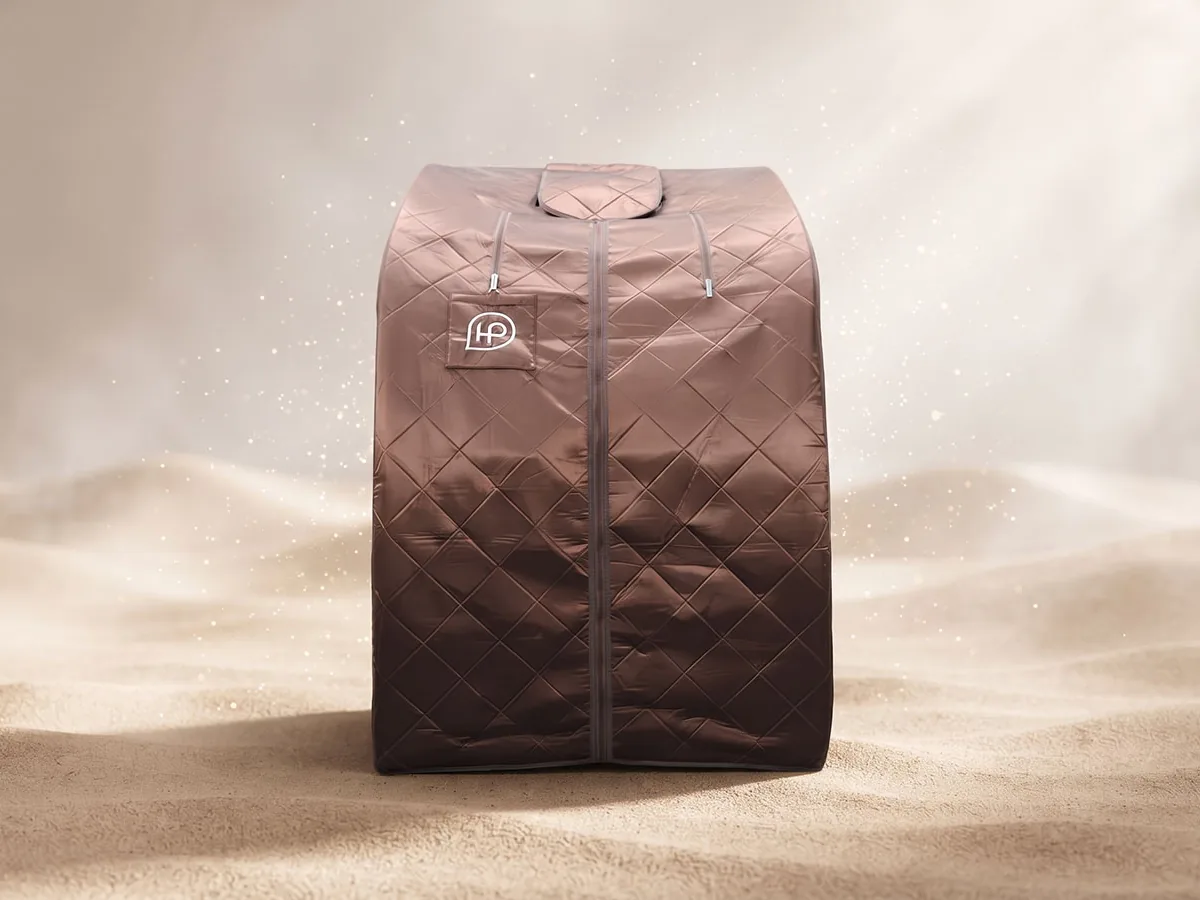
Tourmaline
Heated tourmaline first attracts hot ash, then repels it. That earned it the nickname “Ceylon magnet.” Empress Dowager Cixi loved pink tourmaline so much that she bought it up from the Himalaya mine in California (Wikipedia).
Black jade
The cabin’s second stone. Both heat up along with the cabin and pass their warmth to your body.
Foot mat
It has its own heating: low, medium or high. Your feet, which get cold first, receive warmth separately.
Control panel
Temperature and timer are set in advance, so there’s no need to watch the clock.
Stool and zip
Sit upright; the cabin zips up to your neck, leaving your head and hands free.
The device has passed safety and electromagnetic compatibility testing for its EAEU certificate. The number and validity period are in the “Documents” section.
The Russian bathhouse entered the chronicles more than nine hundred years ago. In the Primary Chronicle (1110s), the Apostle Andrew tells people in Rome about Novgorod: “I saw wooden bathhouses… they douse themselves with tanner’s kvass, raise young switches against themselves and beat themselves… then douse themselves with cold water, and only thus do they revive.” And he adds: “and they make of it a washing for themselves, not a torment” (Wikipedia).
Even earlier, in 907, Prince Oleg wrote into his treaty with Byzantium the right of Rus’ merchants to bathe in Constantinople: “I da tvoryat im mov’, eliko khotyat” — “let them bathe as much as they wish.” That line is 1,119 years old.
In Moscow, the Sanduny have been open since 1808 — the oldest working bathhouse in Russia. Pushkin, Tolstoy, Chekhov, Chaliapin and Mayakovsky all steamed there (Aviasales).
And Finland raised the bath to the heritage of humanity. On 17 December 2020 UNESCO inscribed Finnish sauna culture on the Representative List of Intangible Cultural Heritage — the first Finnish tradition to be listed (Sauna from Finland).
According to the Finnish Sauna Society, the country has about 3.2 million saunas for 5.5 million people. There is even a sauna in the Parliament building.
In the city of Kuopio, sauna lovers were followed for decades. Here is what they found.
A study of the practice, not the device: the Finnish sauna as a habit. Starting in 1984–1989, 2,315 men aged 42–60 were followed for an average of 20.7 years. Among those who went to the sauna 4–7 times a week, 30.8% died over that period. Among those who went once a week, 49.1% (Laukkanen et al., 2015).
A study of the practice, not the device. In 2018 the same link was checked in 1,688 people aged 53–74, more than half of them women. They were followed for 15 years. Among those who went to the sauna 4–7 times a week, deaths from heart and vascular disease were 2.7 per 1,000 person-years. Among those who went once a week — 10.1 (Laukkanen et al., 2018).
A study of an infrared sauna, not our device. In Australia, ten healthy women aged 36 ± 9 spent 45 minutes either resting, sitting in an infrared sauna or pedalling an exercise bike. In the sauna, body temperature measured in the ear rose 1.05 °C above rest and 0.79 °C above the exercise bike (Hussain et al., 2022). Simply sitting in the warmth, the body heated up more than during a workout.
A survey of sauna lovers, not of our device. In the Global Sauna Survey, 83.5% of 482 people said they sleep better after a sauna (Hussain et al., 2019).
You’re always cold
Your hands and feet are icy even at home, and a blanket no longer helps. The mat warms your feet, the cabin your whole body.
You love the bathhouse, but not the trip there
Packing, traffic jams, shared steam and someone else’s schedule. The cabin is waiting for you in your room.
An evening after work
Your mind is still on work, your shoulders like stone. Twenty minutes of warmth with your favourite series — and the day lets go.
Sleep and skin
Asiya writes: “My sleep has become deep. My skin has improved… 20 minutes in the sauna in the evening — I couldn’t be happier.”
No room for a steam room
The cabin folds up and fits in a wardrobe or storage cupboard.
More stories on reviews page.
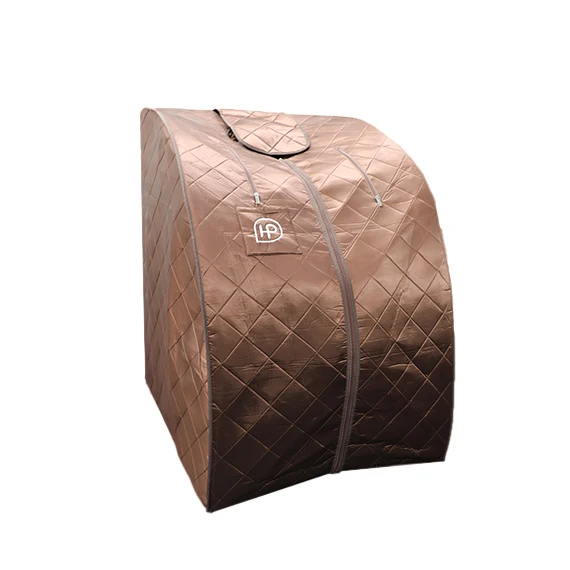
You won’t need a birch whisk, a felt hat or a trip to the bathhouse. All you need is a towel, a glass of warm water and half an hour. The steps follow the official description:
Shower
Shower and remove your make-up before a session.
Food
Don’t start right after a heavy dinner or on an empty stomach.
Water
Drink some warm water before the session, and as much as you like during it.
Session
Sit on the stool and zip up. Set the temperature, the timer for 20–35 minutes and the foot mat heating.
Sweat
Blot it with a towel; don’t rub your body.
After
For six hours, avoid strong wind and cold. For two hours, skip cold drinks and food.
Warmth and sweat come from the very first session. The best thing to do afterwards is a blanket, warm tea and quiet. The evening takes care of itself.
Thyroid disease; pregnancy and childhood; cancer; metal implants in the body; skin and infectious diseases; coronary bypass surgery, pacemakers, severe heart failure; alcohol intoxication and alcohol dependence. No sessions with a high body temperature or acute inflammation. Elderly people in poor health — only under supervision.
KG 417/036.CN.02.01200EAEU certificate
Certificate of conformity for the Ba-gua mini-sauna, serial production. Issued by the certification body Asiastandard in Bishkek; valid from 14 February 2023 to 13 February 2028. Open certificate ↗
TR CU 004/2011Safety
Technical regulation of the Customs Union on the safety of low-voltage equipment. The device was tested to GOST IEC 60335-1, the safety standard for household electrical appliances.
TR CU 020/2011Electromagnetic compatibility
The certificate’s second regulation. The device’s electromagnetic field was measured separately to GOST EN 62233.
Who’s who: WHIEDA sells the Ba-Gua Mini-Sauna in Russia and the CIS.
What can you do in the cabin for 25 minutes?
Your hands are outside, so you can read, scroll through your phone, watch a series or sit with your eyes closed. Your head is in the cool air of the room, so breathing is easy.
How much fluid do you lose per session?
Anastasia A. writes: “It takes up just 1 square metre — and in 20 minutes it draws out 300 grams of excess fluid.” That is water lost with sweat, which is why a glass of warm water before the session is part of the ritual.
Can the whole family use it?
Adults — yes: the cabin folds and fits in any room. Childhood is on the list of contraindications.
How much space does it need?
About a square metre during a session. Afterwards the cabin folds up and is put away.
Signs taken “from one’s own body,” the first of the eight methods and the light bath of royal palaces — all in one folding cabin in your home.
The Ba-Gua Mini-Sauna costs 68,000 ₽. That’s the same as 17–19 two-hour visits to the top-class women’s section of the Sanduny baths (3,500–4,000 ₽, as of 08.10.2026). If you use it three times a week, that’s 156 sessions a year — about 436 ₽ per session. The product card shows whether it is in stock right now.